Falling Pickaxe: what the numbers actually say
Quick rounds, diamond pickaxes and a multiplier that climbs with every block you break: here is how to enjoy Falling Pickaxe from your phone.
Where should you play Falling Pickaxe? Before you deposit anywhere, look at whether the casino is licensed, how cashing out works and which bonus terms matter. Our guide explains what to check. Read the review →
Falling Pickaxe is a drop game from Pixmove Games, released on 18 June 2026. It is not a reel slot, and reading it as one is the quickest way to misjudge it. This page takes the figures the studio publishes and works out what they mean when you sit down to play.
The spec sheet, unembellished
Four numbers describe this title better than any review: the declared return, the volatility rating, the win ceiling and the top of the multiplier ladder. All four point the same way, and that direction is the interesting part.
| Fact | Value | Who publishes it |
|---|---|---|
| Provider | Pixmove Games | Studio |
| Release date | 18 June 2026 | Studio |
| Format | instant-win drop game | Studio |
| RTP | 95% | Studio |
| Volatility | low | Studio |
| Maximum win | x165 / x160 | Pixmove / aggregator databases |
| Multiplier ladder | +0.1 per block, top 50x | Studio |
We print both ceiling figures because both exist: x165 in Pixmove's release announcement and x160 across several aggregator databases. Picking the prettier one would be a lie by omission, and the disagreement itself tells you how little the top end matters on a game pitched this low.
What 95% costs per hour
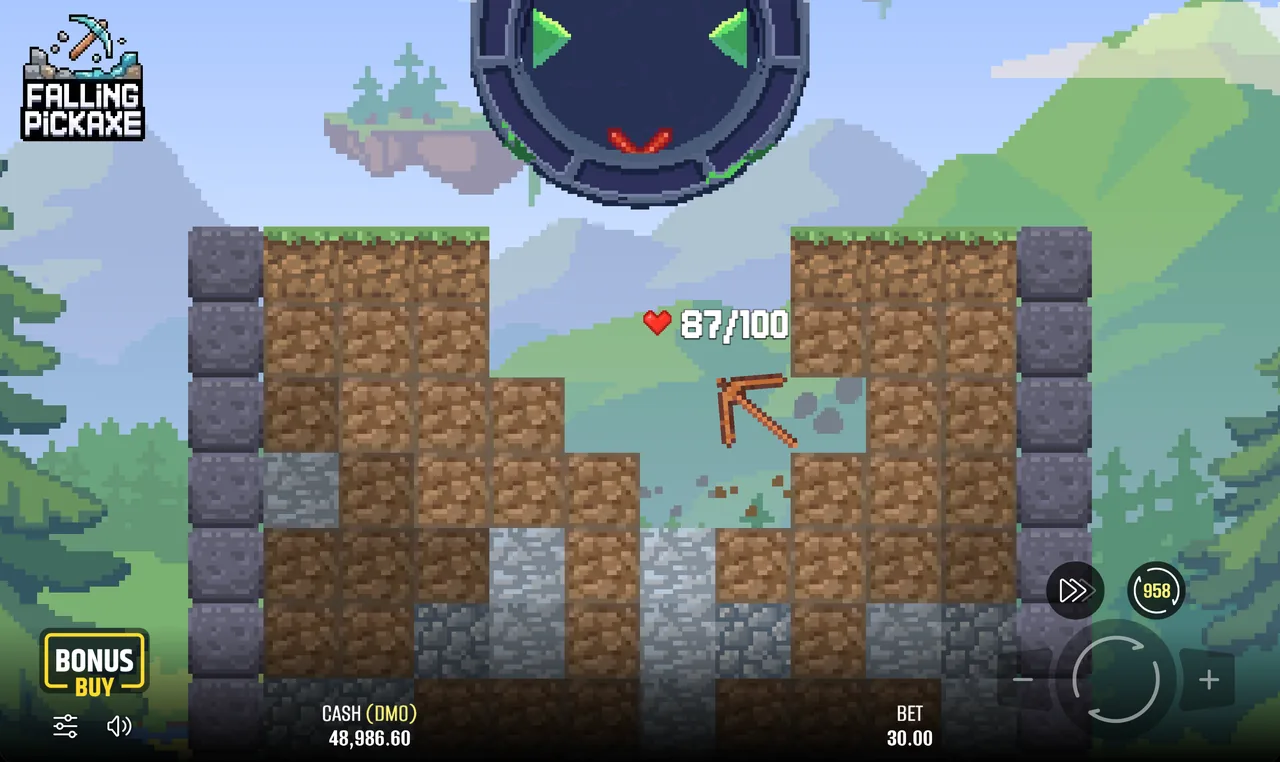
Take a €1 stake and a pace of roughly 400 rounds an hour — quick, but a drop game is quick. That is €400 of turnover, and the model keeps about €20 of it. Against a 96.5% title the same hour costs about €14. The gap is six euro an hour.
Six euro is invisible inside one session and very visible across a month. That is the whole argument: the point and a half separating this game from the ordinary market band is not a spec-sheet detail, it is the price of admission, and it is charged on every round with nothing on screen announcing it.
The less comfortable half of the sentence: €20 is an average. Some hours finish up, most finish down, and the spread around the average is far wider than the average itself. Budget for the spread; the average only tells you which way the ledger leans.
Low volatility and a low ceiling are one statement said twice
The studio rates the volatility low and puts the ceiling at x165. These are not two independent facts: they are the same design decision described from two angles. The return is spread thinly and evenly rather than saved for rare fireworks, and a low ceiling is exactly what makes that work.
That is why the game feels comfortable and why its cost is easy to ignore. A balance that drains in ten-cent steps never produces a moment that feels like a loss. If you pick titles on maximum win, this one is not competing; if you pick them for long cheap sessions, it does exactly what it promises.
How a round resolves
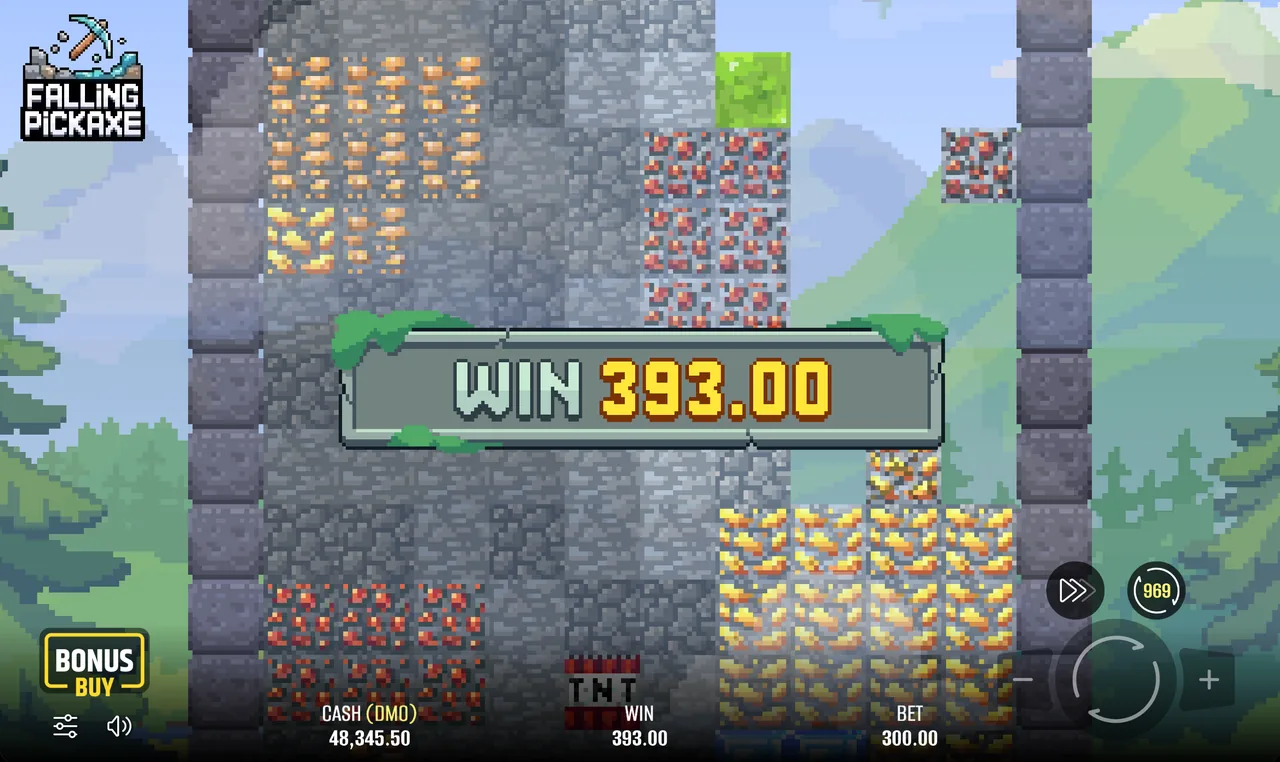
You set the stake and release the pickaxe with one tap. Before the descent the game hands you one of four tools — wooden, stone, iron or diamond — or a cross, which means a round with no pickaxe at all. The draw is random and the timing of your tap does not influence it.
The pickaxe then falls through a shaft of blocks. Dirt and stone pay nothing and only take durability; copper, redstone, gold, diamond and emerald each carry their own multiplier of the stake. Every block broken — filler included — adds 0.1 to the active counter, which starts at 1.0x and climbs to a top of 50x per the studio.
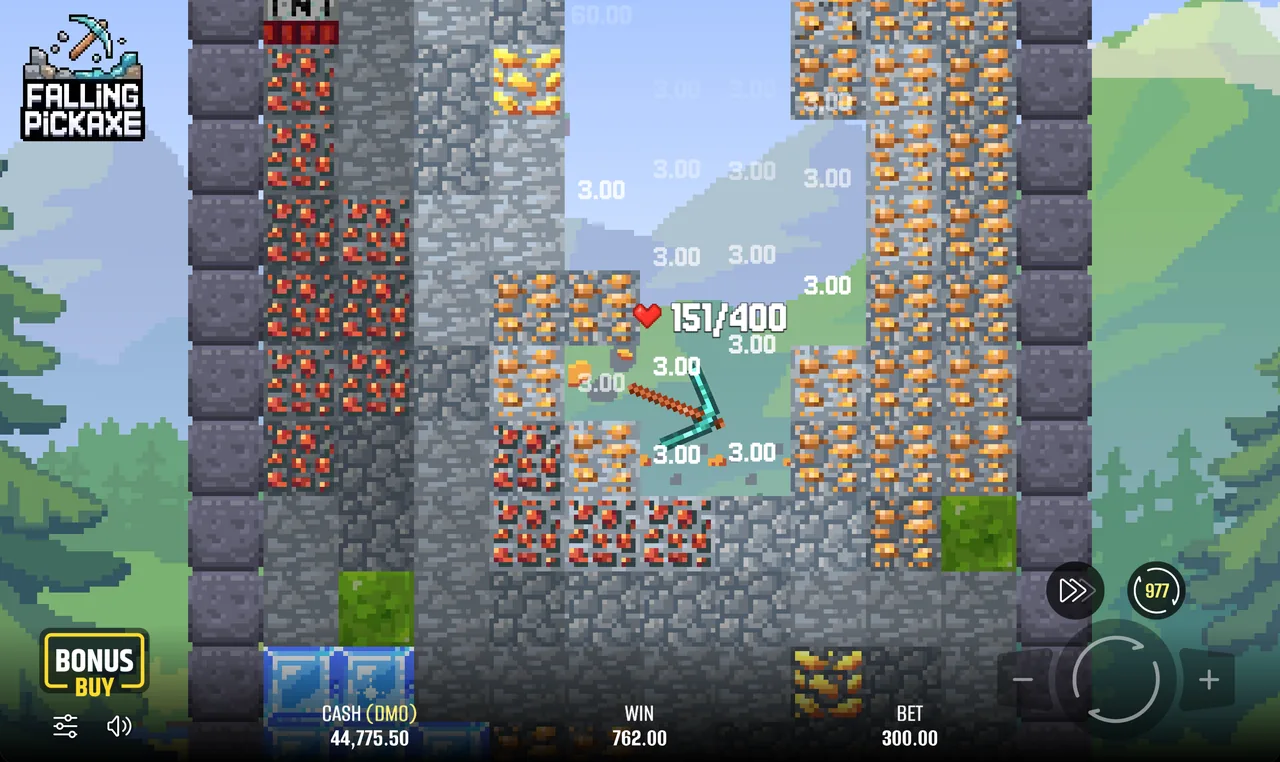
Scattered through the shaft are cells that change the run rather than pay it: a crafting table restores pickaxe health, some blocks widen the pickaxe, and dynamite, arrows, slime and clustered ore alter the trajectory or the yield. Pixmove describes the descent as physics-driven, which is the honest way of saying no two runs resolve the same way.
What RTP does not do
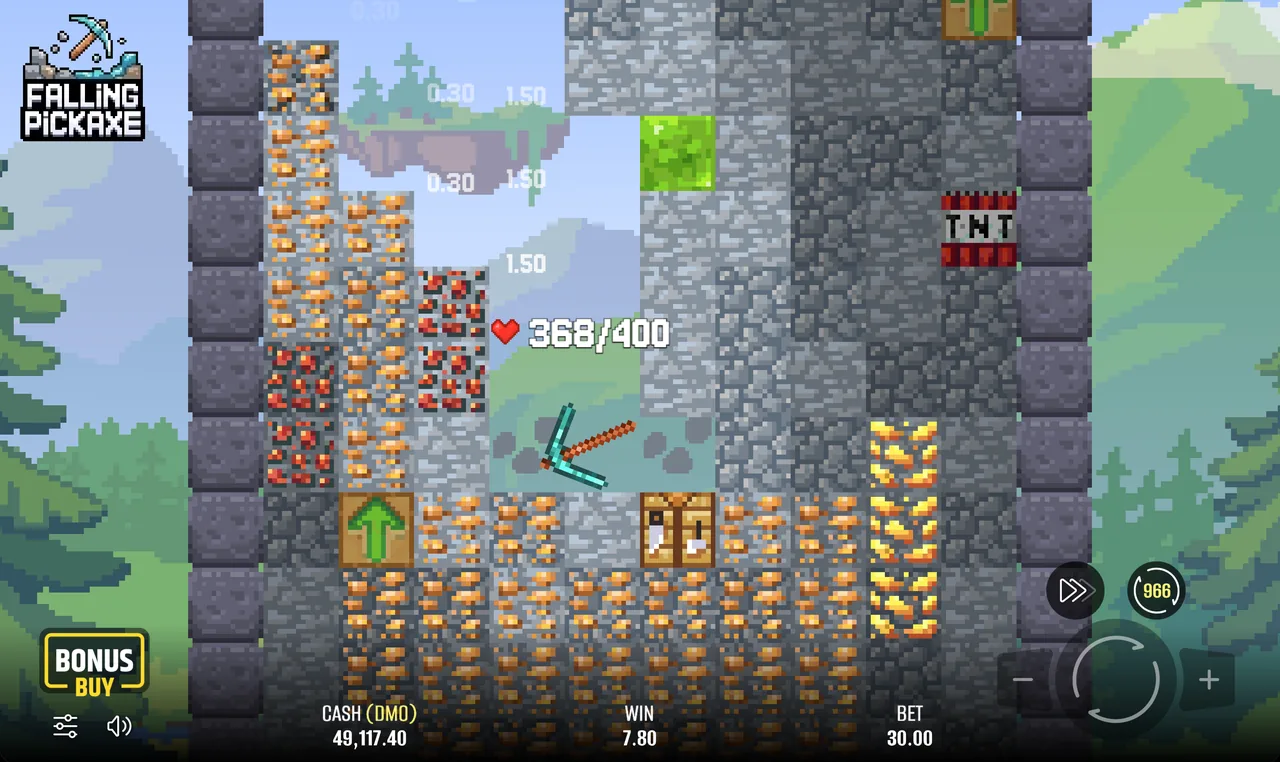
It does not predict your session. It is a theoretical average computed across millions of simulated rounds, and one evening is far too small a sample for the average to show. Two people with the same stake and the same round count will finish in different places, and neither will have seen 95%.
It also does not accumulate. A dry run leaves no payout owing, the generator keeps no memory of the previous round, and no repeated cross makes a diamond pickaxe due. The idea that a payout is 'about to land' is the commonest misreading of this figure, and it is the one that raises stakes at exactly the wrong moment.
Who the game is built for
Pixmove is explicit that the title targets an 18–35 audience through nostalgia and streamer-friendly mechanics. The pixel-art mining aesthetic is doing deliberate work: it looks like a game people already know, which shortens the distance between watching a stream and opening the game yourself.
That is worth naming plainly, because it is the design goal and not an accident. Visual familiarity changes neither the RTP, nor the ceiling, nor the volatility. A game that feels like a childhood afternoon and a game that returns 95% are the same game here.
Not a Minecraft product
The art style is pixel-art mining and the resource names will be familiar, but Falling Pickaxe is a Pixmove Games title and is not a Minecraft product. It is not made, licensed or endorsed by Mojang or Microsoft. Several sites covering this game state or imply otherwise; that claim is wrong and worth ignoring wherever you meet it.
Open Falling Pickaxe at the operator
Everything on this site
- How to play: rules, pickaxes, multiplier
- RTP and volatility: 95% in money
- Demo mode: what to measure in a hundred rounds
- Stake sizing and session budget
- Tricks: what does not work, and why
- Our verdict, with no invented scores
- Similar games and how they differ
- Playing on mobile
- Download: why there is nothing to install
- Bonus terms and wagering
- Payments: methods, timings, fees
- Depositing without surprises
- Withdrawals and verification
- Crypto: what it changes and what it does not
- Registration and identity checks
- Where to play: licence checks in your country
- Support: what to ask and how
- Complaints and escalation
- Self-exclusion and national registers
- Responsible gaming
- Who we are
- Tobias Lindqvist, author
- Affiliate disclosure
- Privacy policy
- Terms and conditions
- Versión en español para España
Frequently asked questions
What is the RTP of Falling Pickaxe?
Pixmove publishes 95%. That sits below the usual 96%-and-up band for modern releases. It is a theoretical long-run average over millions of rounds and says nothing about a single session, but it is the figure that decides the cost of playing this game over time.
What is the maximum win?
Pixmove's release announcement gives x165. Several aggregator databases print x160 for the same game. We quote both and name which is the studio's. Either way the ceiling is low by current standards, which is consistent with the low volatility rating.
How does the multiplier work?
Every block the pickaxe breaks adds 0.1 to the active multiplier, so it climbs 1.1x, 1.2x, 1.3x as the descent continues. The studio puts the top of that ladder at 50x. Dirt and stone break without paying anything themselves, but they still advance the counter.
Is Falling Pickaxe a slot machine?
No. It is an instant-win drop game: there are no reels, no paylines and no spin in the usual sense. A round is a single descent through a shaft of blocks, and its outcome comes from what the pickaxe hits on the way down.
Is this a Minecraft game?
No. Falling Pickaxe is developed and published by Pixmove Games. The pixel-art mining theme is stylistic; there is no licence from or affiliation with Mojang or Microsoft.
Last updated: September 2026