Falling Pickaxe: entertaining and slightly expensive
No stars and no ranking. What follows comes from playing it, plus the arithmetic of what playing it costs.
This page carries no user ratings with names, cities and stars, and no aggregate score in its code. Reproducing opinions we cannot verify would mean inventing them, and a fabricated star average is exactly what makes reviews in this sector worthless. What follows are testing notes signed by this site's author.
What it does well
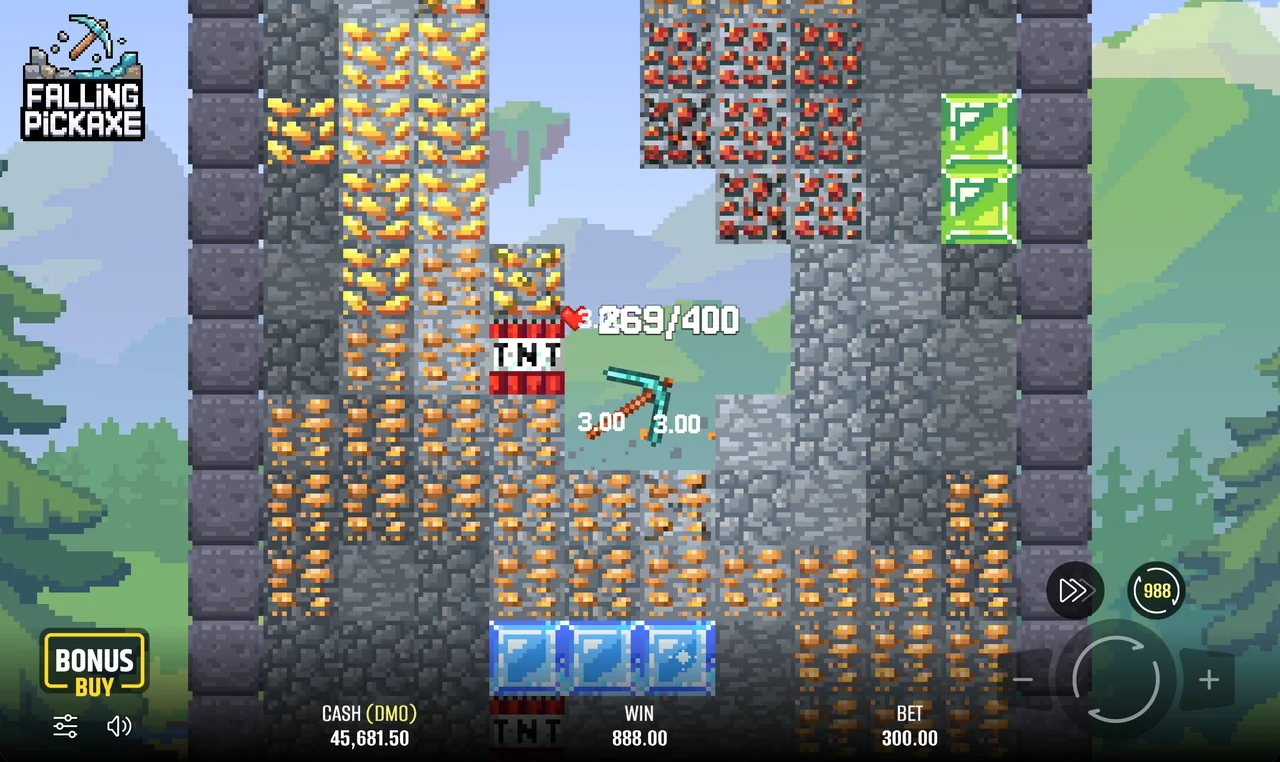
The descent is genuinely entertaining to watch. Physics-driven movement means rounds resolve differently even when the inputs look identical, and the cells that restore health or widen the pickaxe give a short round a shape. For a format with one input, that is more design than it needed.
The pacing is honest too. Rounds are quick, the multiplier counter is always visible, and nothing about the interface hides what is happening. Compared with games that bury their mechanics behind layered menus, this is refreshingly legible.
Where it costs you
The 95% RTP is the weak point and it is not close. Most current releases sit at 96% or above, and on a game this quick the gap compounds faster than it would on a slower format. Pair that with a x165 ceiling and the value proposition is thin: you pay an above-average house edge for a below-average maximum.
The cross — the round that ends before it begins — is the other friction. It is a legitimate part of the design, but it makes a session feel emptier than the hit frequency suggests, and it is the part most people abandon in the first half hour.
Who it suits
Someone who wants a short, cheap, visually familiar game to play in small stakes and quit early. Low volatility makes a small balance last, and the aesthetic delivers exactly what it promises, with no surprises in either direction.
It does not suit anyone choosing on payback, anyone hunting a large multiplier, or anyone planning to clear a wagering requirement — instant-win formats are frequently weighted at zero for that purpose.
If the pixel-art theme is the draw, that is a legitimate reason to play and worth saying out loud. Just price it honestly: the theme costs about a percentage point of return against the market band. Our conclusion is not play or do not play, but know what you are buying.
Testing notes
- The counter climbs continuously and hooks harder than an occasional big prize. That is the mechanism working, not a streak.
- A hundred rounds in the free build are enough to know whether the cross frequency is tolerable. It is the cheapest check available.
- Rounds are fast and the counter is easy to follow, which makes it very easy to play longer than intended: a session timer helps more here than on a slower game.
- The stake range is not published by the studio and is set by each operator, so no figure taken from someone else's table appears on this page.
Those notes are session observations, not statistics: they come from playing at the minimum stake long enough for the rhythm to appear. Where something could not be verified, this page says so instead of filling the gap with a plausible number.
Frequently asked questions
Is Falling Pickaxe worth playing?
It depends what you want. As a short, cheap, visually recognisable format it delivers. As a return proposition it is expensive: 95% sits below the market band and the x165 ceiling does not compensate.
Why are there no stars or scores on this page?
Because an aggregate score we cannot justify is an invented number, and user opinions we cannot verify would be fiction. We publish signed testing notes and the game's arithmetic, both of which can be checked.
Who will not enjoy it?
Anyone choosing a game on payback, anyone hunting a large multiplier and anyone trying to clear a bonus: instant-win formats are commonly weighted below slots or excluded from wagering entirely.
How do you test games?
By playing at the minimum stake long enough for the rhythm to appear: cross frequency, average descent depth before durability runs out, and the typical path of the counter in an ordinary round.
Read on
Last updated: September 2026